
The Break-Even Question: Is a 427 TH/s Machine Worth Starting?
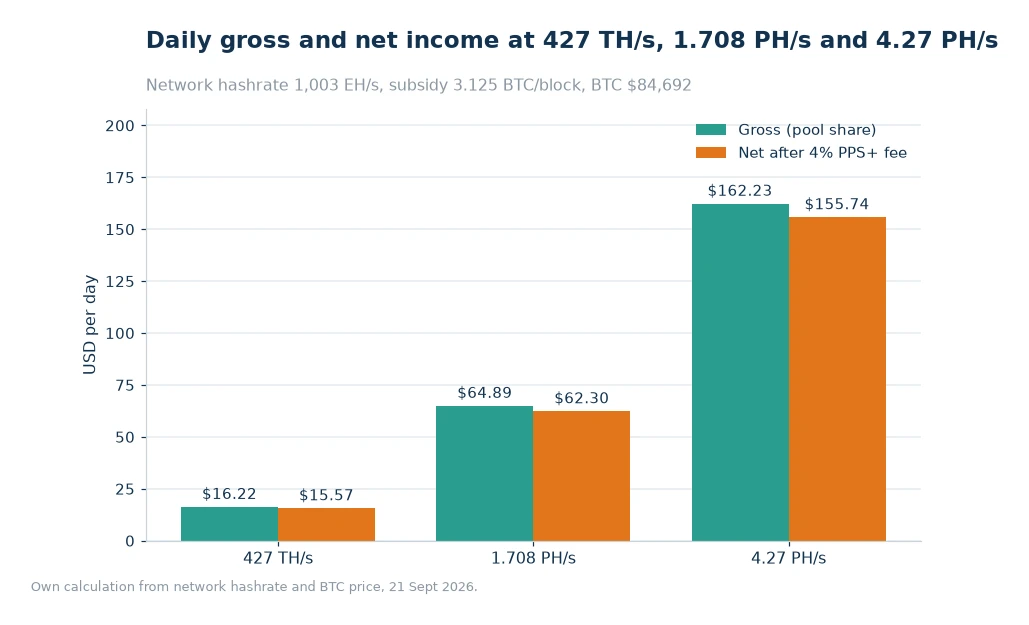
The honest answer to "should I start mining" is a subtraction, not an opinion. A 427 TH/s machine earns about 0.00019155 BTC a day, worth $16.22 gross at $84,692 and $15.57 after the listed 4% on the block-reward component. Whether that is worth doing depends entirely on what the machine draws from the wall and what the kilowatt-hour costs where it stands.
Key takeaways
- 427 TH/s at 20 J/TH draws 8.54 kW, which is about 205 kWh a day.
- At $0.06/kWh the power bill is roughly $12.30 a day against $15.57 of net credits.
- The margin before hardware is about $3.27 a day, so the payback period is measured in years, not months.
- A tariff of $0.08/kWh erases most of that margin without changing the machine.
Begin with watts, not terahashes
Hashrate is the number printed on the box, and it is the least interesting figure for a beginner. The one that determines survival is efficiency, expressed in joules per terahash. A machine at 20 J/TH producing 427 TH/s consumes 8,540 watts; the same hashrate at 30 J/TH consumes 12,810. The second machine earns exactly the same coins and costs half again as much to run.
Convert that to a daily unit. 8.54 kW running for 24 hours is 204.96 kWh. Multiply by the tariff and the operating cost appears. At $0.06 that is $12.30 a day; at $0.10 it is $20.50, which is more than the machine earns. Nothing about the pool changed between those two sentences, and yet one is a business and the other is a hobby with a subscription.
This is why miners talk about tariffs before they talk about models. The hardware sets the upper bound on what is possible; the electricity price sets whether any of it is available to you.
What actually lands in the account
Revenue is not gross hashrate value. Under PPS+, the block-reward component is credited hourly against current difficulty with a listed 4% deducted, while the transaction-fee component follows PPLNS logic at a listed 2%. The practical daily figure for 427 TH/s is $15.57 net at the reference price, and that is the number to hold against the power bill.
Ignore, for a moment, the hardware cost. If credits are $15.57 and power is $12.30, the machine contributes $3.27 a day toward its own purchase and everything else. That is the true operating margin, and it is thin enough that a fan failure or a two-day outage matters.
A miner who only looks at the gross figure will conclude the operation is comfortable. A miner who subtracts power sees a business running on a 21% margin before capital costs. Both are looking at the same machine.
| Line | Monthly USD | How it is derived |
|---|---|---|
| Gross credits | $486.60 | 30 × $16.22 |
| Listed fee effect | −$19.50 | 4% on the block-reward component |
| Net credits | $467.10 | 30 × $15.57 |
| Power at $0.06/kWh | −$369.00 | 205 kWh a day × 30 × $0.06 |
| Before hardware | $98.10 | Net credits less power |
The last line is the one that answers the question. It is what the machine gives back each month before a single dollar of purchase price, shipping, a spare PSU or a replacement fan is counted.
Worked example
Run the whole calculation in one pass, then change one input to see how fragile the result is.
- Every terahash claims 450 ÷ 1,003,000,000 = 0.00000044865 BTC a day.
- 427 TH/s: 427 × 0.00000044865 = 0.00019155 BTC a day.
- Gross dollars: 0.00019155 × 84,692 = $16.22.
- Subtract the 4% listed on the block reward: 16.22 × 0.96 = $15.57.
- Power draw at 20 J/TH: 427 × 20 = 8,540 W, or 8.54 kW.
- Daily energy: 8.54 × 24 = 204.96 kWh; at $0.06 that is $12.30.
- Daily margin: $15.57 − $12.30 = $3.27; monthly margin: $98.10.
- At $0.08/kWh the power line becomes $16.40 and the margin turns negative by $0.83 a day.
Step eight is the whole article. A two-cent change in the tariff, which nobody controls, flips a marginal operation into a losing one. That is the risk a buyer is underwriting when the margin is this narrow.
Where scale changes the answer
Four units at 1.708 PH/s produce $62.30 net a day against roughly $49.20 of power at the same tariff, leaving about $13.10. Ten units at 4.27 PH/s leave about $32.75. The margin per machine barely moves, but the absolute number grows enough to absorb a repair or a bad month.
Scale also changes the tariff. A site drawing 85 kW can often negotiate a better industrial rate than a garage drawing 8.5 kW, and that single improvement does more for the economics than any firmware tweak. It is also the reason hosted mining exists: someone else already has the cheaper power and the paperwork that goes with it.
A beginner should decide which of the two games they are playing. One machine at home is a hobby with a small return and a large learning value. Ten machines is an operating business with contracts, spares and a maintenance calendar. Both are legitimate; confusing them is how people buy ten before they have run one.
There is also a middle stage worth naming, because it catches most people. Two or three units in a spare room are still small enough to manage by hand and large enough that the power bill becomes visible to whoever else pays it. That is the stage where a dedicated circuit and a proper exhaust are usually installed, and the cost of both belongs in the payback sum rather than in a separate budget labeled "workshop."
The Statistics view shows the network total behind the daily rate, so a thinner margin can be traced to difficulty instead of being blamed on the machine.
When the numbers say wait
There are three honest reasons to delay a purchase. The first is a tariff above roughly $0.07/kWh at this efficiency, which leaves too little room. The second is a machine whose efficiency is unknown or worse than 25 J/TH, because the power line will dominate. The third is an inability to fund a replacement without selling the coins the machine produces.
None of those are permanent. Tariffs change, hardware improves, and a miner who waits a quarter with a spreadsheet is not losing anything except the depreciation they avoided. The Profit Calculator will redo the revenue side whenever difficulty moves, which makes waiting an active decision rather than an idle one.
The ViaBTC Bitcoin Mining account is free to open and useful before any hardware arrives, because it shows the settlement rhythm you will be reading later. A month of watching credits with no machine attached teaches more about pool behavior than a week of reading.
Frequently asked questions
How much power does a 427 TH/s miner use?
At 20 J/TH it draws 8,540 watts, or about 205 kWh a day, which costs $12.30 at a tariff of $0.06 per kilowatt-hour.
What is a realistic margin for one machine at home?
At these inputs the daily net credit is $15.57 against $12.30 of power, leaving $3.27 a day before hardware costs, which is a thin margin rather than a windfall.
Does a cheaper machine improve the economics?
Only if its efficiency is comparable; a low purchase price with a high joules-per-terahash figure usually costs more over a year than a better unit bought at a premium.
Decide in a spreadsheet, not in a checkout page
Write four numbers on one line: net daily credit, daily power cost, purchase price and expected life. Divide the price by the daily margin and you have a payback estimate that can be compared with any other use of the money. If the answer is measured in years, the purchase is a bet on difficulty and price, and it should be sized like one.
Then run the machine for a month before buying the second. A single month at your own tariff, with your own uptime, will teach you more than this article can.
Sources: ViaBTC calculator and account pages for revenue estimates and settlement detail[1]. Published 24 Oct 2026, using 21 Sept 2026 data: $84,692 per BTC, 1,003 EH/s, 132.76 T difficulty, 3.125 BTC per block, 144 blocks a day. Power prices here are illustrative tariffs, not quotes.