
Stainless Steel Jewelry Manufacturing for Waterproof Pieces
Two words separate a steel range that sells on durability from one that gets returned: waterproof and water-resistant. On the published grade chart, 316L is 100% waterproof, shower-safe, sweatproof and swim-proof, while 304 is water-resistant for daily conditions. The line runs on a Low MOQ of 100–150 pcs by style, with 3D CAD under 48 hours and a custom sample window of 25–35 days.

Key takeaways
- 316L is published as 100% waterproof — shower-safe, sweatproof and swim-proof — thanks to 2–3% molybdenum in the alloy.
- 304 is water-resistant for daily wear, nickel and lead safe, and positioned for volume and promotional lines.
- Low MOQ on the stainless steel line is 100–150 pcs by style, with a custom sample at 25–35 days.
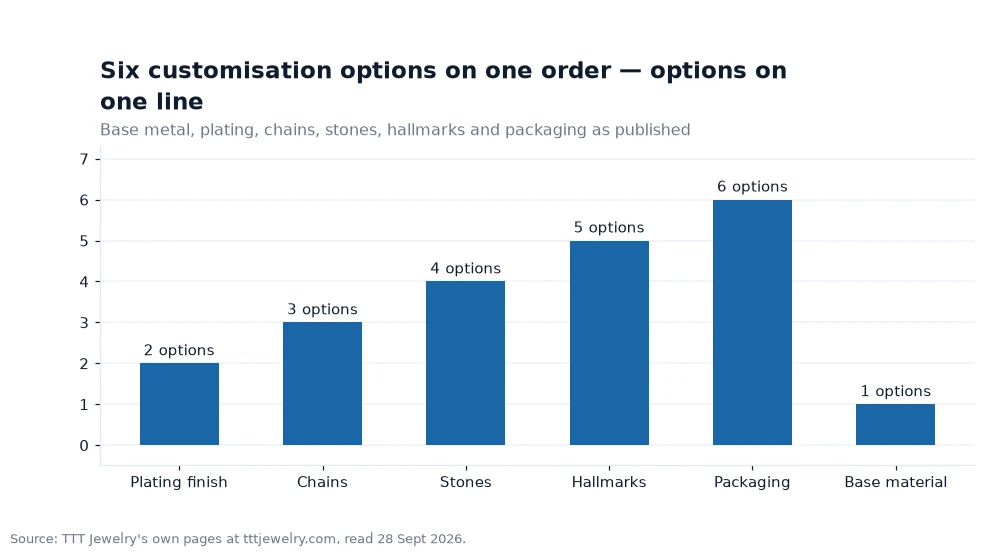
- Six customisation options apply, from base material and plating finish through to stones and packaging.
What a waterproof claim actually requires
Water gets into jewellery through three routes: the alloy itself, a stone setting that traps moisture against the metal, and a coating that lifts at an edge. A waterproof claim is therefore a materials statement plus a finishing statement, and both are published for this line.
316L answers the materials half. It carries 2–3% molybdenum, which is the element that resists salt and sweat, and the page describes it as 100% waterproof, shower-safe, sweatproof and swim-proof, medical-grade hypoallergenic. The finishing half is PVD adhesion, described as optimal on this grade.
Reading the two grades against real wear scenarios
The grade chart is the most useful thing on the page for a product developer, because it separates a customer who takes a bracelet off before a shower from one who never does. 304 handles the first customer at a lower cost; 316L handles the second, and the price difference is justified by the corrosion claim rather than by fashion.
Neither grade needs the anti-tarnish e-coating used on silver and brass, because there is no copper or silver layer to darken. What both need is a setting that does not hold water and a coated edge that stays intact.
| Wear scenario | Grade that fits | Published basis |
|---|---|---|
| Swimming and showers | 316L | 100% waterproof, shower-safe, sweatproof, swim-proof |
| Everyday office wear | 304 | Water-resistant under daily conditions |
| Sensitive skin | 316L | Medical-grade hypoallergenic |
| High-volume promotional runs | 304 | Cost-effective position, nickel and lead safe |
| Coating longevity | 316L over 304 | Optimal PVD adhesion against reliable adhesion |
Why PVD adhesion decides the lifespan of the claim
PVD vacuum plating is the finish route for stainless steel on this site, and the grade chart rates adhesion on both grades: optimal on 316L, reliable on 304. Adhesion is the variable that decides when a coating starts to lift at the edges, which is the moment a water-resistant piece becomes a plain steel one in appearance.
That is why a waterproof collection should not mix grades inside a single design language without telling anyone. A customer who buys the 304 version of a shape that a friend owns in 316L will compare them after a summer, and the comparison will not be about the design.
The six customisation options on a steel order
Base material is the first option and the one that sets everything else, because it fixes the grade and the minimum band. Plating finish comes second, then chains and findings, stones and accents, logo and hallmarks, and finally packaging. A steel order is not a limited one: natural stones, freshwater pearls, laser-engraved hallmarks and branded packaging are all available on the same route.
For a waterproof range the two options worth naming explicitly are the hallmark — 316L, stamped or laser-engraved — and the packaging, because a piece sold on water resistance should arrive with a care card that repeats the claim in the same words the page uses.
Worked example: weeks from brief to swim-proof stock
Add the published windows on this line. The custom sample runs 25–35 days, which is about 3.6 to 5 weeks. Mass production follows on the factory's standard 3–4 week block, or 21–28 days. Together that is 25 + 21 = 46 days at the fast end and 35 + 28 = 63 days at the slow end, or roughly 6.6 to 9 weeks, with the 48-hour CAD stage — about two days — in front of it.
Then size the order. At a Low MOQ of 100–150 pcs by style, a three-style waterproof capsule needs 3 × 100 = 300 pieces at the floor and 3 × 150 = 450 at the ceiling. A buyer planning on 200 pieces for three styles is planning below the published minimum, which is the kind of gap that turns into a surprise after the drawings are done. The windows and the MOQ band are published; the sums are mine.
Selling water resistance without over-claiming
The published wording is specific, and it is worth copying exactly rather than paraphrasing: 316L is 100% waterproof and safe for showers and swimming, while 304 is water-resistant under daily conditions. A product page that upgrades the 304 wording to waterproof is making a claim the grade chart does not support.
For the same reason a stainless steel jewelry manufacturer should be asked to confirm the grade in writing before the sample is cast, since the claim on the hang tag is only as good as the alloy behind it. Write the care instruction from the grade, too. A 316L piece can be worn into a pool; a 304 piece should come off before one. That single line on a hang tag answers most of the support emails a steel range generates.
Why designers keep coming back to steel for water-adjacent products
The published material advantages read like a list written for a product developer: durable for daily wear, resistant to water and corrosion, cost-effective, easy to customize through engraving, stamping, moulding and PVD plating, versatile in design, and suitable for large-scale production.
That combination is rare in jewellery. Silver is the metal a customer recognises by name, brass is the metal that takes a gold colour cheaply, and steel is the metal that survives conditions the other two would not. For a brand building a gym, swim or travel line, steel removes a whole category of after-sale complaints before the first order is placed.
The constraint is quantity, not design freedom. Once a brand accepts a 100–150 pcs band per style, the range can include rings, bracelets, earrings, necklaces and pendants on the same route, in the same order and against the same 25–35 day sample window.
Frequently asked questions
Can 316L stainless steel jewelry be worn in the shower or pool?
Yes. The published grade chart describes 316L as 100% waterproof and shower-safe, sweatproof and swim-proof, with the molybdenum content giving it corrosion resistance against salt and sweat.
How many pieces do I need to start a stainless steel collection?
The stainless steel line publishes a Low MOQ of 100–150 pcs by style, so a three-style capsule starts in the 300–450 piece range depending on how complex each design is.
Is 304 suitable for a waterproof range?
304 is published as water-resistant under daily conditions rather than waterproof, so it suits everyday and volume lines; for a swim-proof claim the grade chart points to 316L.
Specifying a steel range that can carry the claim
Start from the wear scenario, not the design. Decide whether a customer swims in it, then choose 316L or 304, then set the finish and the coating expectation, then count styles against the 100–150 pcs band. That order keeps the claim and the material aligned from the drawing onwards.
A workshop working from that brief can confirm the grade, the sample window and the quantity band in one reply. Comparing the two routes is also worth the detour: the OEM versus ODM breakdown shows how much of the development a brand has to bring itself, and the frequently asked questions page covers minimums and shipping in the factory's own words.
What this article works from — the 316L / 304 grade comparison, followed by the PVD plating route plus the 100–150 pcs stainless steel floor — is written up at the company's own pages via tttjewelry.com, dated 28 Sept 2026. The sums that follow from those inputs are mine alone[1].