
Five Questions to Settle Before Signing With a Bespoke Fragrance Developer
Bespoke fragrance development is a sequence of decisions, and the mistake most established beauty brands make is signing before five of them are settled. The sections that cause trouble later are not price and not lead time; they are who defines the scent, who owns it, how many rounds the brief buys, how change is priced, and what happens if the scent is right but the filling is wrong. Settle those five and the development phase becomes ordinary project management. Leave any of them open and the same phase becomes a negotiation with no leverage left on your side.
Key takeaways
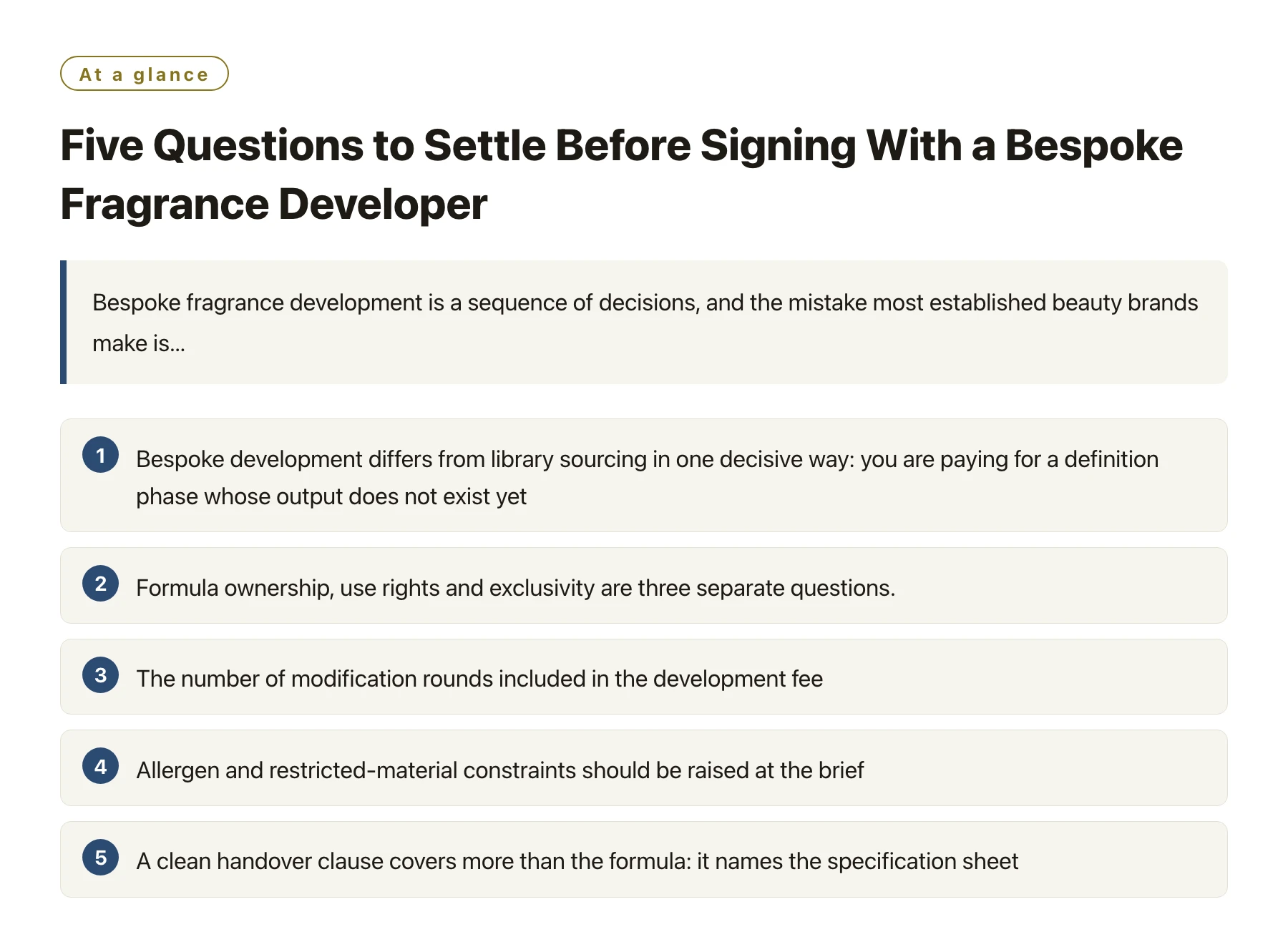
- Bespoke development differs from library sourcing in one decisive way: you are paying for a definition phase whose output does not exist yet, so the agreement must describe deliverables and rounds rather than a finished product.
- Formula ownership, use rights and exclusivity are three separate questions. An established brand needs all three answered in writing, because out-sourcing a scent does not automatically transfer the rights to it. [1]
- The number of modification rounds included in the development fee, and the price of each additional round, should be agreed before sampling starts; this single number explains most disputes about cost later in a project.
- Allergen and restricted-material constraints should be raised at the brief, not at the stability stage, so the perfumer works inside the destination market's rules from the first trial. [2]
- A clean handover clause covers more than the formula: it names the specification sheet, the batch record, the packaging drawings and the retention samples, and states which of them travel with the brand if the relationship ends.
- Suppliers that answer ownership and change-control questions precisely on the first call are usually the ones whose development process is documented, which matters more for bespoke work than for any other sourcing model.
Bespoke development is the part of fragrance sourcing where the buyer has least visibility and the most exposure. There is no catalogue to inspect, no unit price to compare across three vendors, and no way to know whether the scent in front of you was the perfumer's third idea or thirtieth. What a brand can control is the structure of the agreement and the order in which decisions are made.
This is written from a product development perspective rather than a procurement one. The question is not how to get the lowest development fee, which is a rounding error next to a launch delay, but how to make sure the project can be either finished or stopped without either side holding the other hostage.
The five gates, in the order we recommend closing them
- Gate 1 - What exactly are we buying?Define whether the deliverable is an exclusive formula, a modified library accord with limited exclusivity, or a fully bespoke composition. Each has a different price structure and a different ownership default, and the difference must be stated in one sentence before anything else is discussed.
- Gate 2 - Who owns what, and where?Ask for formula ownership, use rights and territorial or channel exclusivity as three separate lines. Ownership without use rights is a trap, and use rights without exclusivity may be acceptable if the price reflects it. [1]
- Gate 3 - How many rounds does the fee buy?Get a number in writing, plus the price of extra rounds, and define what counts as a round: a dosage adjustment, a material substitution, or a re-brief all cost different amounts of perfumer time.
- Gate 4 - What constraints are locked?Target market, product category, alcohol or aqueous base, packaging materials, and cost ceiling. Allergen and restricted-material limits belong here, at the brief, so the perfumer does not spend three rounds on a composition that cannot be labelled for the market. [2]
- Gate 5 - What does handover include?Specification sheet, batch record, stability data, and the packaging drawings tied to the fragrance. Name the documents and the format in advance; asking for them after the relationship cools is when goodwill runs out.
What the signature actually commits you to
A bespoke agreement commits the brand to two different things: development work that has not happened yet and production capacity that is not yet defined. Buyers usually negotiate the second and forget the first, which is why so many projects reach a technically successful sample and then stall on commercial terms that were never written down.
Put the sample specification next to the production specification at signing. If the agreement only describes the sample, the brand has bought a scent, not a supply relationship, and every change needed to make the scent manufacturable at volume becomes an extra-cost conversation.
Gate questions translated into contract lines
| Question to ask on the call | What the answer defines | How to record it |
|---|---|---|
| Is the scent exclusive to us, and in which markets? | Exclusivity scope and duration | A named territory list, a channel list and an end date |
| Do we receive the formula itself or only the finished oil? | Ownership and continuity if you move supplier | A clause listing the deliverables and their format |
| How many modification rounds are included? | Development fee coverage and change pricing | A round count plus a unit price for extra rounds |
| What documentation ships with the first bulk order? | Traceability and audit readiness | A document list in an annex, not in an email |
| Who pays for rejected samples and repeated stability work? | Which party carries technical risk | A split stated by cause, not by volume |
Each row can be settled in a fifteen-minute conversation. What makes bespoke development expensive is not asking them at all, then discovering the answers once the brand has committed to a launch date.
What to watch for in the supplier's own behaviour
They move to signature quickly
Speed is not a red flag by itself, but a supplier that wants to sign before the exclusivity scope and the round count are defined is transferring all the ambiguity to you. Ask for those two lines in writing before the contract is drafted.
They answer ownership questions with reassurance
"It is your formula" is not an answer. Ask who holds the formula file, whether it is documented to a specification, and what happens to it if the relationship ends. Those three follow-ups separate a documented development process from a verbal promise.
They cannot price extra rounds
A fixed development fee with no extra-round price means the supplier has no model of its own perfumer time. Expect that gap to be filled later at whatever price the moment allows.
Bring three short documents to the signing meeting: your brief, a one-page specification of what the scent must be, and a list of the documents you expect at handover. Compare notes against a developer that publishes how it structures bespoke work; if you want a worked example of that structure, Visit the website to see how the scope of a custom project is described before any fee is quoted. A development partner who has to be taught the structure of the agreement will cost more in review cycles than one who arrives with it.
Two things that are genuinely negotiable
Exclusivity and price are the two variables most worth trading. A brand that only sells in two markets may not need worldwide exclusivity, and dropping that requirement often buys a lower development fee or more included rounds than haggling over the fee directly. What should not be traded is documentation: the specification sheet, the batch record and the stability data are the difference between a supply relationship and a dependency.
The same logic applies when the brief is still forming. Reading how the checks that matter before signing a contract frames the evidence list is a useful check on your own list, because the questions a buyer brings to the table shape how much the supplier prepares.
Sources
- WIPO — World Intellectual Property Organization —— The UN agency for intellectual property; resources on industrial design and patent protection relevant to product and packaging design.
- IFRA Standards Library (International Fragrance Association) —— The IFRA Standards Library lists the restrictions the fragrance industry applies to individual fragrance ingredients, based on safety assessments; it is the reference point for compliant fragrance formulation.
Frequently asked questions
At what point should a brand sign a bespoke fragrance development agreement?
After the exclusivity scope, deliverable definition, round count and handover document list are agreed in writing. Price can still move after that, but the structural terms should be fixed before the perfumer starts real development work, because changing them afterwards shifts all the leverage to one side.
Does the brand own the formula if it pays for development?
Not automatically. Ownership depends on what the agreement says and on whether the composition derives from the supplier's existing library. Ask for the formula file, its format, and the conditions under which it transfers; where the scent is a modification of a library accord, expect ownership and use rights to be split rather than fully transferred.
How many sample rounds should a bespoke project include?
For a defined fine fragrance brief with a clear direction, three to four rounds is a realistic structure for an established brand. Projects that need more rounds usually reflect an unsettled brief rather than a difficult perfume, which is why the brief itself deserves the same attention as the contract.
Should exclusivity be global or limited to our markets?
Limit it to the markets and channels you actually sell in. Global exclusivity raises the development fee and narrows the supplier's options, whereas territory-limited exclusivity is cheaper and usually sufficient. Revisit the scope when the brand expands, rather than paying upfront for markets you may never enter.
What if the sample is right but production cannot match it?
That gap is why the production specification belongs in the agreement. Ask the supplier to state, before signing, which aspects of the sample are reproducible at scale and which depend on hand-bench work. A supplier that cannot answer this has not thought about the scale-up step.
Apply for Membership
Translate evidence-based phototherapy research into bedside practice alongside 11,400+ clinicians worldwide.